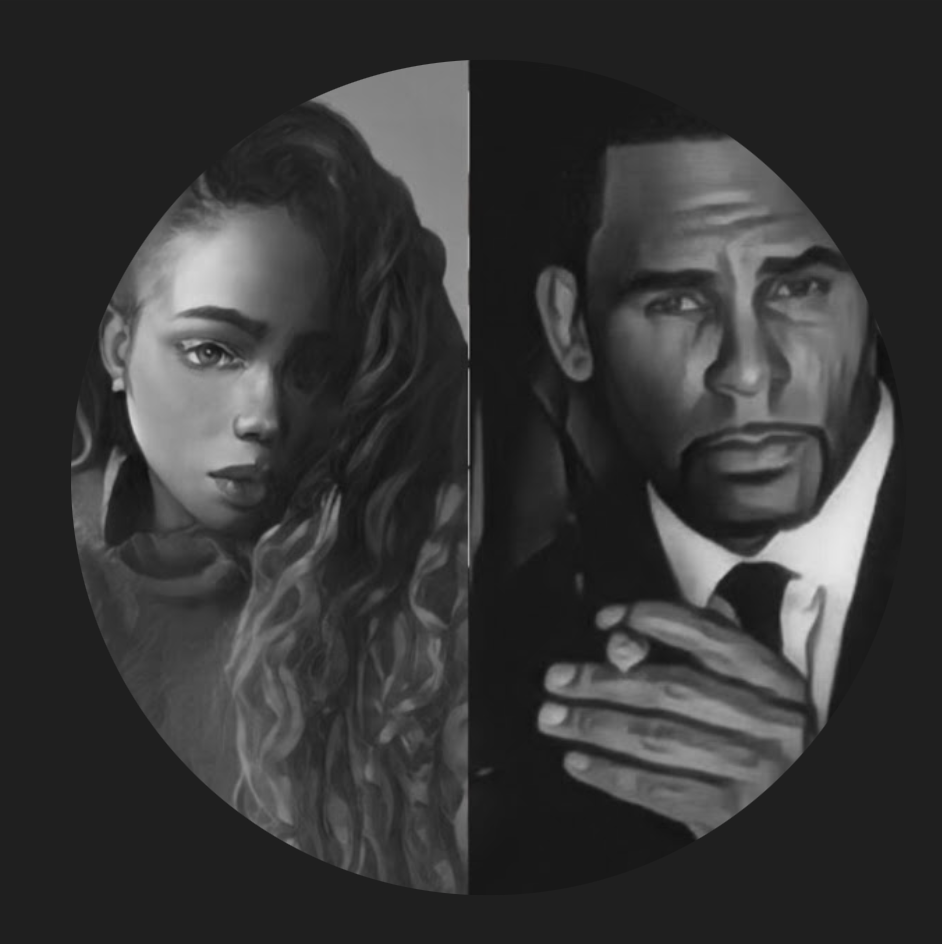
Song of Songs 4:7
“You are altogether beautiful, my love;
there is no flaw in you.”

Love Through Fire
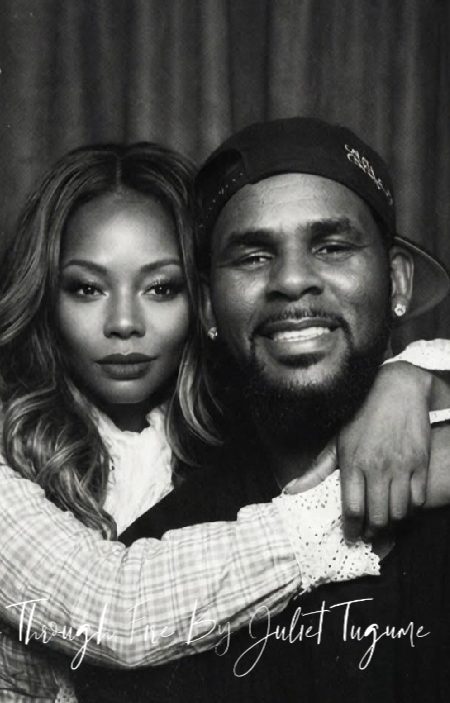
Hello, my name is Juliet. Publicly, I am known as Juliet Tugume.
Tugume is my spiritual middle name, given to me at baptism by my mother. I was born during the civil war in Uganda, during the time of Idi Amin. My mother chose the name carefully. Tugume means “to be strong.” It was not simply a name — it was a prophecy, a covering, and a prayer spoken over my life at a time when survival itself required faith.
Strength has followed me in ways I could not have foreseen.



Song of Songs 3:4 – “I found him whom my soul loves. I held him, and would not let him go.”
I’m a country music artist at heart — a qualified photographer and designer by trade —, but in recent years my world has gently reshaped itself into something far more intimate. I’ve been studying integrative medicine, yes, but even more than that, I’ve been nurturing a quieter, sweeter dream.




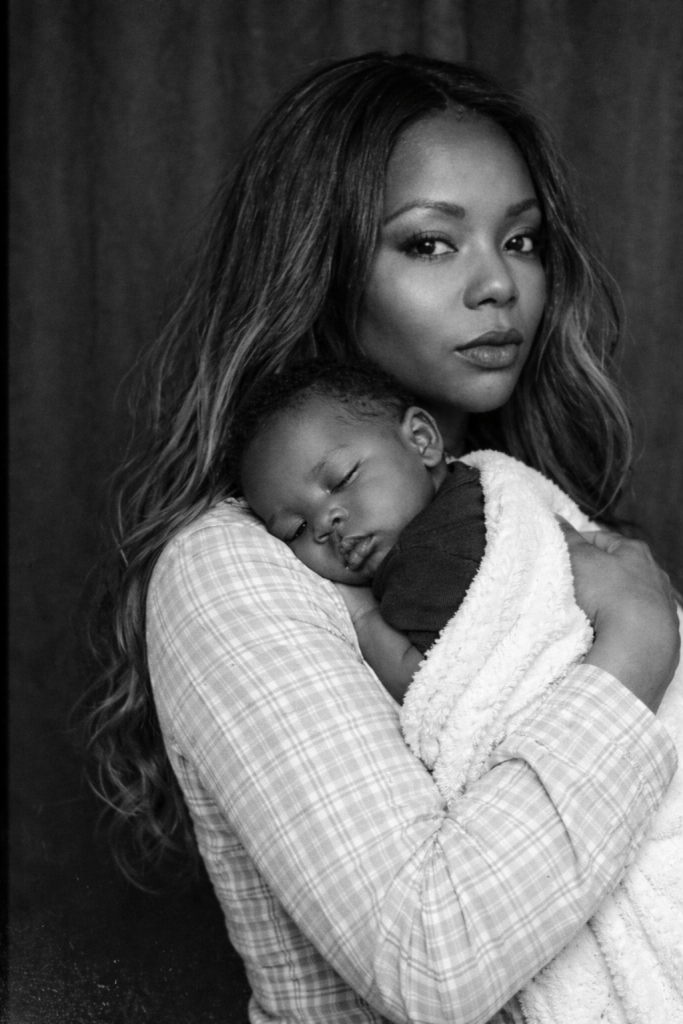

A life that feels like a love song unfolding. Music drifting through open windows, something warm baking in the oven, boots by the door, and a home filled with laughter. Homemaking has become its own kind of art to me — a sacred, creative act.
At the centre of it all is my deepest passion, building a family, and weaving melody, meaning, and tenderness into the everyday rhythms of Robert and my life together.
I’ve been preparing for his long-awaited homecoming.
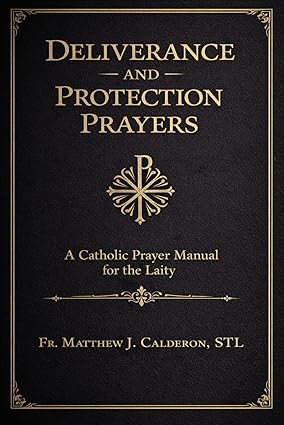
who prays for deliverance and protection,
who wears a black lace veil while saying my rosary,
even in the quiet of being alone
with the Word of God open before me.
I am aware of the evil spirits that roam this earth,
and I have heard the stirrings of souls
that priests have told me dwell in the in-between.
There are those who have never truly seen
the spirit world at work—
never heard the ghostly sounds,
never witnessed what it looks like
when a person may be overtaken by something dark.
And so they deny it,
to steady their minds,
to convince themselves
that nothing in this world is truly evil.
Perhaps because someone charming online
once told them that God does not care.
But it was
a bishop from Chicago,
who gave me words to understand it this way:
If this world is so complex,
so detailed beyond our human understanding,
so vast and diverse in ways we cannot fully grasp,
then how could the spirit world be any less?
Would it not also be vast and varied,
filled with spirits and presences
beyond what we could ever comprehend?
And so I pray—
the Our Father,
my Hail Marys,
and more besides.
Because when facing evil spirits in people,
prayer is, by far,
the most powerful thing you can do.
Eph 6:12
“Prayer: Sober discernment and steady Trust
Heavenly Father, I place myself before you with honesty and simplicity. If I am unsettled, calm me. If I am afraid, strengthen me. If I am confused, guide me. Give me the grace to discern with peace and without exaggeration. Protect me from false interpretations and from needless fear.
Teach me to remain in the present moment, and to trust your providence. I ask for the help of the Blessed Virgin Mary, Saint Joseph, and my guardian angel. Keep me close to Jesus, gentle and humble of heart.
Amen.
Prayer: Prayer for the light of Christ in the mind
Lord Jesus Christ, you are the light that no darkness can overcome. Shine in my thoughts and in my imagination. Guard me from intrusive worries and from ruminations that steal peace. Give me clarity, patience, and a quiet confidence in your protection. Let your peace rule in my heart, and let it shape my decisions today.
Amen.
Prayer to refuse fear based interpretation
Father, when I am tempted to read every discomfort as danger, guide me. When I am tempted to magnify what is small, bring me back to reality. When I am tempted to obsess, teach me to stop. Give me the grace to trust you, to seek counsel when needed, and to live with peaceful prudence. I rest in your care. I belong to you.
Amen.“
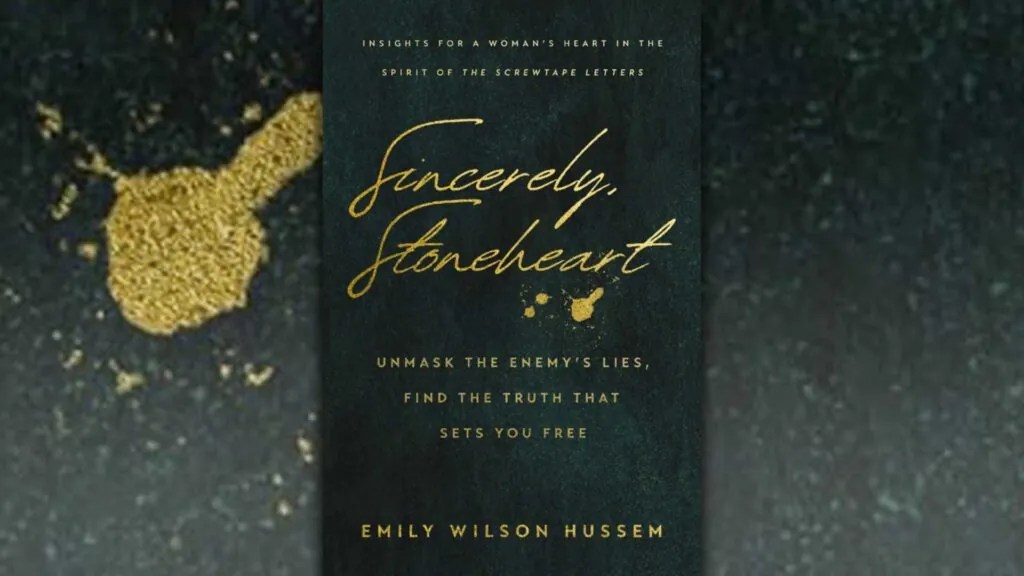
Sincerely, Stoneheart is a compelling, imaginative portrayal of a senior demon coaching a junior demon about how best to deceive, distract, and enslave women, Hussem not only unmasks the Enemy’s lies but empowers women to overcome those lies. As you journey through the eye-opening correspondences of Sincerely, Stoneheart, you will
Identify the insidious web of lies and tactics that keep you from living into the freedom you were designed for
Draw strength from the reality that you are not in this battle alone
Become equipped to stand against the calculated, specific attacks on your heart that are especially prevalent today
Learn to step into the life of meaning, joy, and freedom that God intends for you
The Enemy does not want you to be free. But no spiritual darkness, emotional weariness, or negative thought patterns can stand against the light of God’s grace, truth, and hope. Sincerely, Stoneheart invites you to look with new eyes at your faith, your daily choices, and your self-image through the beautiful reality that your true identity—mind, heart, and soul—is beloved.








I am Robert’s real and only partner. I say this not to provoke, but to clarify my position in his life. Had Robert not been imprisoned and entangled in a profound injustice, we would have been married long ago. The word “partner” is not my preferred label, because it does not fully represent what we are to each other. However, marriage itself is a partnership, and in the absence of the spiritual – legal ceremony that circumstances prevented, it is the closest word available in the public sphere.
Song of Songs – “I am my beloved’s,
and his desire is for me.”


I am far more than a girlfriend. We have navigated these legal trials together in ways few could understand from the outside. I have been present. I have endured. I have prayed. I have researched. I have stood firm.
Robert is entirely his own man. He has his own thoughts, his own decisions, and his own autonomy. There were times during this process when, due to legal strategy and external pressures, we had to operate independently. I explain those periods in detail throughout this blog. Independence in certain seasons did not alter the substance of our bond, nor my place in his life.
While some have attempted to erase me from his narrative, Robert never did. He kept me at the forefront of his heart and mind, even in moments that appeared contradictory from the outside. There were public statements he made under circumstances that many will not fully understand. From my perspective, those moments reflected complex legal and strategic pressures rather than the truth of his private loyalties. I recognize that others may interpret those events differently, and I respect that this is an area of public speculation. What I can speak to is what I personally experienced and what I know of our private understanding.
I know some readers will struggle to comprehend certain aspects of our story. Some may approach it with skepticism. Some may approach it with criticism. Others may simply lack the life experience that makes certain dynamics intelligible — particularly the rare and overwhelming experience of meeting a person who is the love of your life, your soulmate, and even your twin.
Some will choose not to understand. I write knowing that.
And some sincerely seek understanding. I write for them too.
To those of faith, I ask that you pray sincerely for wisdom and discernment as you read. To those without faith, I ask only that you consider the possibility that faith itself may illuminate dimensions of this story for you that your logic alone cannot fully explain.
I genuinely believe that one of the missing pieces in how Robert’s story has been interpreted publicly is the absence of spiritual framing — the absence of God’s guidance in discourse, in media representation, and in the collective rush to judgment. Whether one believes in God or not, values and moral orientation shape how we interpret events. My interpretation is faith-informed. I do not hide that.



This blog — which will one day become a fully published book — is dedicated to my love, Robert Sylvester Kelly.
I call him my heart because my heart is filled to the brim with love every time I think about him. There is not a moment when he is absent from my thoughts, my prayers, or my inner world. His heart and mine have always felt like mirrors — reflecting the same convictions, the same spiritual hunger, the same belief in enduring love.
Many people speak today about trauma bonds. Very little is spoken about what I believe is the healthy opposite — a bond formed not through shared wounds, but through shared wholeness and through God. Two hearts aligned. Two spirits recognizing each other. Two souls with identical morals, ideas, convictions, and purpose.
Some call this phenomenon “twin flames,” an attempt to explain how two people born on opposite sides of the world can feel as though they were born together. When Robert and I first met, we experienced what others might describe as mystical or extraordinary moments — an immediate, unspoken understanding. It felt as though we had grown up together, yet what connected us was deeper than shared history. It felt spiritual.

Paulo Coelho once wrote:
“Lovers don’t finally meet somewhere, they’re in each other all along.”
That is the closest language I have found to describe us.
What complicates our story is not our bond, but fame. Fame is not natural. It magnifies rumors. It turns human beings into symbols. Had we lived ordinary private lives, many of the events discussed here would never have unfolded publicly.
Robert has spoken about his shyness. As a young man, he was deeply private. I was the same as a child. Shy people do not seek attention for its own sake. I have often reflected on how many great entertainers were inward, reserved souls. I believe legacy is tied to calling, not self-promotion. God sees intention.
I began this blog because I believed there was room for perspective — from someone who has known Robert intimately for over seven years. I know his heart, his temperament, his faith, and his struggles. As Christians, we would likely have been married by now had circumstances been different. Instead, I write as his partner — not as a legal representative, not as an official spokesperson — but as someone who loves him deeply.
Some people have interpreted Robert’s public silence as an admission. From my experience, it reflected reliance on legal counsel and a belief in due process. He followed the advice not to litigate his case in the media. He trusted that the legal system would function fairly. He also lives with dyslexia, which affects reading, writing, numerical processing, and sometimes verbal fluency under extreme pressure. Public interviews are not always conducive environments for someone who is both neurologically wired that way and deeply private.
However, it is here that I feel compelled to address something broader — what I believe to be a modern blind spot in how public accusation intersects with human rights principles.
Article 11 of the Universal Declaration of Human Rights affirms that every person charged with a penal offense has the right to be presumed innocent until proven guilty according to law in a public trial with all guarantees necessary for defense.
In principle, this protection is foundational.
In practice — particularly for public figures — it is more complicated.

The presumption of innocence applies in a courtroom. It does not prevent global media outlets from broadcasting allegations before trial. It does not prevent documentary filmmakers from presenting curated narratives. It does not prevent public movements from forming collective opinions as fact before the verdict.
It does not shield a person from reputational collapse long before evidence is fully examined and tested in court. Nor does it, in itself, prevent the possibility of bias — whether conscious or unconscious — among jurors, judges, or prosecutors, including situations where personal beliefs, political considerations, or external pressures may influence perception.
Due process also does not automatically guard against the risk of coercive or underhanded tactics that critics sometimes allege can occur within adversarial legal systems. Prosecutors and judges often operate with significant legal protections and immunities, which can make accountability for misconduct complex and difficult to pursue where concerns arise.
Likewise, the system is not immune to the possibility that dishonest or unreliable witnesses may attempt to weaponize legal mechanisms for personal motives. Nor does the principle of due process, on its own, guarantee competent or diligent defense representation; ineffective, negligent, or strategically flawed counsel can profoundly impact outcomes.
In theory, due process establishes safeguards. In practice, its effectiveness depends entirely on the integrity, competence, and good faith of the human beings operating within it.
It does not stop advertisers, platforms, or institutions from distancing themselves based on public pressure.
Movements such as #MeToo, Times Up and campaigns like “Mute R. Kelly” operated in a cultural space that profoundly shaped public perception long before legal proceedings concluded. I understand that many supporters of such movements believe they are advocating for victims and accountability. My concern is not with the stated ideals of justice or protection of the vulnerable.
My concern is with what happens when public activism, media amplification, and social media virality combine to create a climate in which allegations are widely treated as established fact before trial.
In my view, this creates a tension between advocacy and due process that must be addressed in terms of civil rights.
It can produce what feels like a court of public opinion that operates independently of evidentiary standards. It can incentivize simplified narratives over complex legal realities. It can create enormous social pressure on corporations, media platforms, and institutions to take positions that appear morally aligned before courts have completed their work.
In Robert’s case, media portrayals, organized boycotts, and widespread digital campaigns significantly influenced public perception. Whether intentionally or unintentionally, the cumulative effect was that the presumption of innocence — while legally intact in theory — did not function meaningfully in the cultural sphere.
The right to due process exists within a legal framework. Reputation exists in a social one.
When the social framework moves faster than the legal one, the damage can precede adjudication.
Nothing in this blog is meant to minimize or dismiss the trauma experienced by children or by anyone who has genuinely been assaulted, trafficked, or harmed. The suffering of the truly vulnerable is real and deserving of compassion, protection, and justice. Robert and I are united in our desire to see those who are genuinely at risk safeguarded and supported. Robert is a real survivor of childhood abuse, but by women.
At the same time, I believe meaningful protection begins closest to home — within families, neighborhoods, and local communities where early intervention, accountability, and care can have a tangible impact. Real change, in my view, grows from consistent, grounded action in everyday spaces, rather than from reactive outrage on social media or campaigns that focus primarily on celebrities.
Reliable research shows that most traffickers are not “famous public figures.”
Rather:
- Families, neighbors, community acquaintances, or organized criminal networks are far more commonly involved.
- A long-term review of trafficking cases found that over 50% of child trafficking victims were recruited by family members or friends rather than unknown strangers.
There is no credible global data that public figures — e.g., celebrities, politicians, entertainers — are a statistically significant proportion of traffickers.
The majority of traffickers are not public figures. Research shows that children are more likely to be trafficked by those in their own communities, including family, acquaintances, or organized groups. I believe the intense focus on celebrities and their lifestyles distracts from the real perpetrators and those who are truly vulnerable.
Love Through Fire Foundation
This blog reflects my lived experience, my interpretation of public records, and my personal concerns about how modern media ecosystems interact with legal processes. Where I critique systems, movements, or media practices, I do so as a private citizen expressing opinion —
If any factual errors are identified and supported by verifiable documentation, I am open to correction.
Love Through Fire exists because I believe love is stronger than distortion, faith is stronger than fear, and truth deserves room to breathe — even when the world is loud.
— Juliet Tugume
I am also known as Juliette A.O., and you may occasionally see my name written in this way. Juliette is the Belgian-French version of Juliet, reflecting my birthplace. The “A” represents my additional middle name, given to me by my father, and the “O” stands for my surname.



Song of Songs 1:15-16
“Behold, you are beautiful, my love…
Behold, you are beautiful, my beloved, truly delightful.”

 Love Through Fire...